Yes, a check valve can be installed vertically, but two critical conditions must be met: the fluid flow must be upward only, and a spring-assisted check valve must be used. Standard swing check valves without spring assistance are designed for horizontal installation only; forcing them into a vertical position will cause seal failure and severe leakage.
Key Rules for Vertical Check Valve Installation
A check valve (also known as a non-return valve or one-way valve) prevents backflow and protects pumps, compressors, and other critical equipment. In vertical piping, gravity significantly affects disc movement, so the following installation rules must be strictly followed:
Flow Direction Must Be Upward
All vertically installed check valves require fluid to flow from bottom to top. If the flow direction is downward, gravity will pull the disc open continuously, rendering the check valve completely ineffective against backflow. Before installation, always verify the flow arrow on the valve body and ensure it points in the same direction as the media flow.
Spring Assistance Is Mandatory
In horizontal piping, swing check valves rely on disc weight and back pressure to seal shut. In vertical piping, gravity works against the closing direction, so the disc cannot fall back by its own weight. Therefore, vertical installations must use spring-assisted check valves. The spring snaps the disc back onto the seat the instant the pump stops, preventing a long water column from crashing down. Ignoring the spring requirement can lead to water hammer and pipe burst.
Position Away from Turbulence Sources
Check valves should be installed on straight pipe runs with at least 5 pipe diameters of straight pipe upstream and 10 to 15 pipe diameters downstream. For example, if the pipe diameter is 2 inches (about 50mm), there should be at least 10 inches (about 250mm) of straight pipe before the valve and 20 to 30 inches (about 500 to 750mm) after the valve. Installing near elbows, tees, or pump outlets causes turbulent flow, leading to uneven disc loading, vibration, noise, and premature wear.
Vertical Installation Suitability by Check Valve Type
Not all check valve designs are suitable for vertical installation. The following comparison covers common types:
| Check Valve Type |
Vertical Install |
Requirements |
Notes |
| Swing Check Valve |
Up-flow only |
Spring-assisted |
Standard non-spring models are for horizontal use only; vertical installation requires product specs explicitly stating "suitable for vertical up-flow" |
| Lift Check Valve |
Up-flow only |
Inlet at bottom |
Disc moves vertically along guide posts, suitable for vertical pipes; downward flow prevents disc closure |
| Spring-Loaded Axial Check Valve |
Suitable |
Flow arrow pointing up |
Engineered for vertical pipes; spring tension overcomes gravity; lowest water hammer risk, ideal for high-rise building risers |
| Butterfly Check Valve |
Suitable |
Any orientation |
Uses flexible reinforced elastomer seal with no metal components; quick response in any position; 2" to 8" sizes rated at 150 psi (about 1.03 MPa) |
| Diaphragm Check Valve |
Suitable |
Correct flow direction |
Diaphragm made of Santoprene TPE; rated at 150 psi full-flow open, 100 psi back pressure closed (water at 73 degrees F / 23 degrees C) |
| Ball Check Valve |
Up-flow only |
Flow arrow pointing up |
Ball relies on gravity to seat; vertical installation requires flow direction matching the arrow, otherwise the ball cannot seal |
Engineering Parameters for Vertical Installation
In plastic piping systems (PVC, CPVC, PP materials), vertical check valve installation requires attention to the following technical parameters:
Higher Cracking Pressure Requirement
When installed vertically, the pump must overcome three resistance factors to open the disc: disc weight, spring preload, and water column weight. Horizontal installations typically have cracking pressures below 0.5 psi (about 3.4 kPa), while spring-assisted vertical check valves may require 2 to 14 psi (about 14 to 97 kPa), equivalent to 5 to 32 feet of head. If the pump head is insufficient, the disc will "flutter" - rapidly oscillating between partially open and closed states, causing noise and accelerated wear.
Flow Velocity Limits
Media velocity through plastic check valves should not exceed 5 feet per second (about 1.5 meters per second). Excessive velocity increases disc impact force and shortens seal life. In high-rise building water risers, flow velocity should be controlled through pipe sizing or pressure reducing valves.
Temperature-Pressure Derating
Plastic valve pressure ratings decrease as temperature rises. For PVC material, the pressure rating is 150 psi at 73 degrees F (23 degrees C), but drops to 50 psi at 140 degrees F (60 degrees C). When installed vertically in hot water systems, the temperature-pressure derating factor must be verified to avoid overpressure operation.
Typical Vertical Installation Applications
Vertical check valve installation is essential in the following scenarios:
- High-rise building water supply risers: Prevents water column fallback when pumps stop, protecting rooftop tanks and ground-floor pumps
- Deep well pump systems: Installed on vertical discharge pipes to prevent well water from flowing back into the well
- Sump pump drainage systems: Prevents sewage backflow in vertical discharge lines from submersible pumps
- HVAC cooling towers: Maintains one-way flow in vertical circulation pipes
- Chemical vertical transfer pipelines: Prevents backflow contamination when corrosive media is lifted vertically
Common Installation Errors and Consequences
| Error Type |
Specific Issue |
Consequence |
| Reversed Flow Direction |
Check valve installed upside down, arrow pointing opposite to flow |
Disc cannot open or close properly, complete system failure |
| Non-Spring Type in Vertical Pipe |
Standard swing check valve without spring installed vertically |
Disc cannot return to seat, continuous leakage |
| Downward Flow Installation |
Fluid flows downward through the check valve |
Gravity keeps disc open, check function completely lost |
| Installed Near Elbow |
Less than 5 pipe diameters of straight pipe upstream of valve |
Turbulence causes uneven disc loading, vibration, and seal failure |
| Insufficient Pipe Support |
Vertical pipe lacks adequate brackets or hangers |
Pipe movement stresses valve joints, causing connection leaks |
Installation Procedure Guide
Follow these steps to ensure correct vertical installation:
- Shut off fluid supply: Before installation, cut off pipeline flow, depressurize, and drain residual liquid from the pipe
- Inspect valve condition: Verify the disc moves freely without binding; check sealing surfaces for scratches or foreign particles
- Confirm flow direction marking: Locate the flow arrow on the valve body and ensure it aligns with the upward flow direction in the pipe
- Provide straight pipe runs: Maintain 5 pipe diameters of straight pipe upstream and 10 to 15 pipe diameters downstream
- Connect properly: For plastic valves with socket or threaded connections, use a strap wrench to tighten hand-tight plus no more than 1/16 turn; never use conventional pipe wrenches to avoid damaging the valve body
- Secure piping: Install pipe supports above and below the valve to prevent pipe weight and flow shock from transferring to the valve
- Test operation: Slowly open fluid supply and check for leaks; stop the pump and observe whether the disc closes quickly with no backflow
Maintenance and Inspection Points
Vertically installed check valves require periodic inspection of the following items:
- Check for leakage at valve-to-pipe connections, especially threaded and flanged joints
- Listen for abnormal operating noise; knocking sounds may indicate disc flutter or spring failure
- Periodically inspect seals (EPDM or FKM O-rings) and replace if hardened or cracked
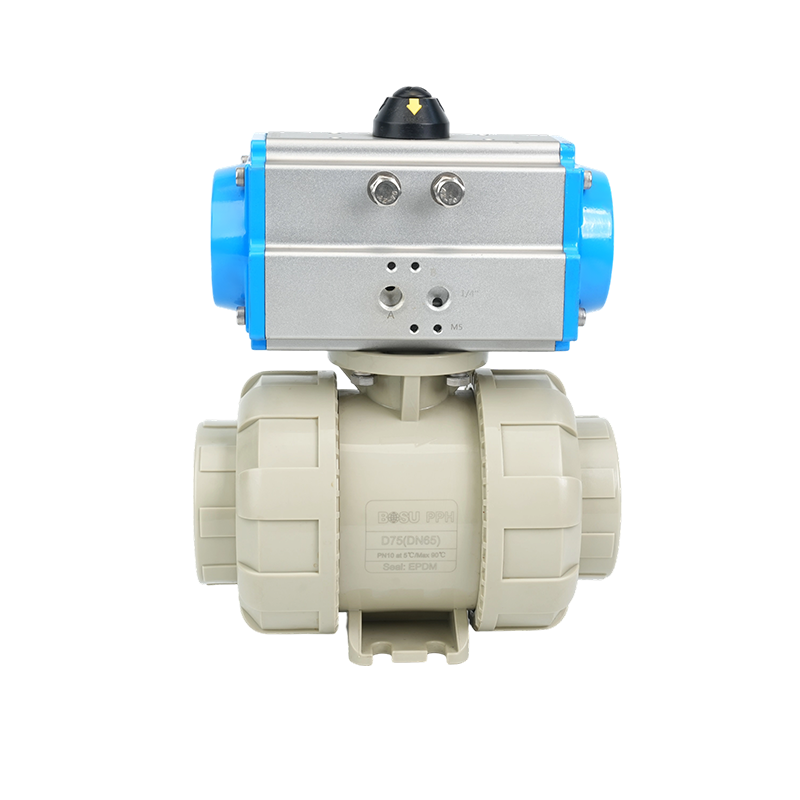
- Clean internal deposits; plastic check valves with True Union design allow in-line cartridge replacement without cutting the pipeline
- Verify spring tension; springs may fatigue over long-term use, causing delayed closure
Selection Recommendations
When selecting a check valve for vertical installation in plastic piping systems, prioritize the following features:
- Match valve body material to pipe material (e.g., PVC valve for PVC pipe) to minimize galvanic corrosion risk
- Select seal material based on media: EPDM for water and weak acids/alkalis; FKM for oils and strongly corrosive media
- Prioritize True Union construction for easy in-line maintenance and replacement
- Confirm product specifications explicitly state "Suitable for Vertical Up-flow Installation"
- For 1/2 inch to 4 inch sizes, standard pressure ratings are 150 psi full-flow open / 75 psi closed (water at 73 degrees F)